
Mention metal 3D printing, and most people picture a dedicated machine enclosed in a cabinet, a beam scanning slowly across metal powder on a build platform. FANUC's recently announced approach is not that: it puts its six-axis vertically articulated M-800 series robots front and center, with the arm holding a directed energy deposition (DED) print head that laser-melts metal powder or wire and "stacks" parts up layer by layer. The robot body's absolute accuracy is about ten times better than before, reaching ±0.1 mm, with trajectory accuracy for straight lines and arcs also at ±0.1 mm. The targets are the large, complex-shaped parts that dedicated machines cannot reach.
First, the key points in order:
- FANUC is building its metal AM (additive manufacturing) system around the M-800 series machining robot, adopting DED tools from other manufacturers, and offering the whole as a complete system solution to customers;
- The robot body's absolute accuracy improves roughly tenfold over previous levels to ±0.1 mm, with straight-line and arc trajectory accuracy also at ±0.1 mm;
- Compared with dedicated machines limited by build-platform size, the robot has a much larger working envelope, and focuses on large, complex-shaped parts;
- The deposition tool sits with outside suppliers, while accuracy, rigidity and control are FANUC's own — who takes responsibility for the quality of the whole system is the strategic focal point;
- The accuracy gain is a precondition, not a guarantee: forming speed, deposit quality and material stability still have to be proven on real parts.
From "Removing" to "Stacking": A Machining Robot Changes Trades
The M-800's pedigree deserves a word. It started life as a machining robot for cutting and grinding, spending decades on "subtractive" work — carving away the excess from a blank. Now FANUC has switched it to the opposite trade: "stacking" material on layer by layer. On the tool side, the DED print head — which laser-melts metal powder or wire and deposits it layer by layer — comes from another manufacturer; what FANUC does is make the arm carry that head along sufficiently accurate trajectories, then package the whole thing as a system solution.
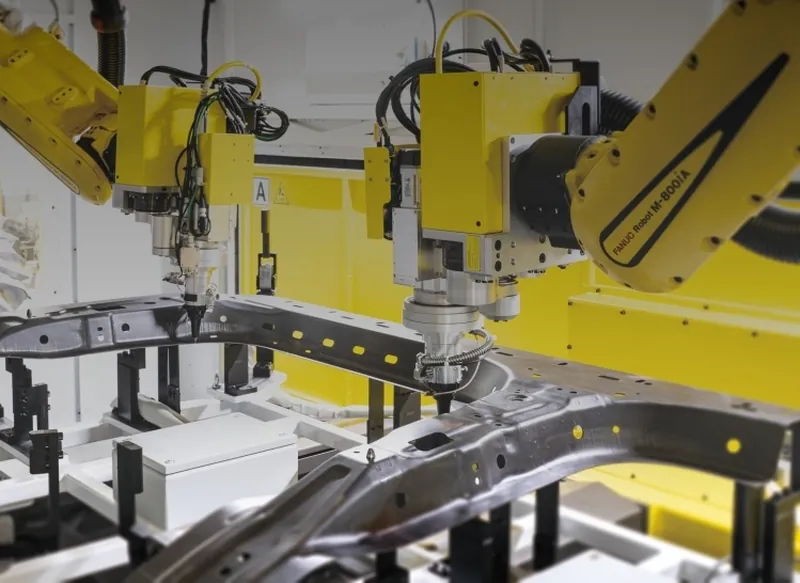
The improvement in body performance is substantial. According to FANUC, its in-house analysis methods, combined with calibration technology that captures and compensates for each robot's individual differences, deliver high rigidity and ±0.1 mm absolute accuracy — roughly ten times previous products. Managing Executive Officer Kenichiro Abe explains: "Teaching is completed simply by entering values, and even complex-shaped parts can be produced by metal AM with high accuracy."
Absolute Accuracy and Repeatability: The One-Word Difference Is the Critical One
For robots doing machining, the long-standing weakness has been accuracy. A multi-joint arm inevitably flexes, and there is always some deviation between where it is told to go and where it actually arrives. Two often-conflated terms need separating here: repeatability measures how faithfully the same motion is reproduced over and over; absolute accuracy measures how close the end effector actually comes to the commanded coordinates. Making a robot "hit the mark" relies on the latter. The higher the absolute accuracy, the more directly the robot can move according to the numbers on the drawing, without repeated trial-and-error correction against the physical part. A roughly tenfold improvement plus per-unit calibration and compensation means the adjustment workload for trajectory deviations shrinks sharply — which is what makes a "type in the numbers and go" style of teaching stand up.
But to be complete about it: this is only the half of accuracy that delivers the end effector to the target position. The dimensions and forming quality of the finished part depend on the DED process link — melting, solidification, layer-by-layer build-up. Positioning accuracy is one necessary condition for high-quality metal AM, not a sufficient one; on its own it cannot determine the final quality of the part.
Why a Robot Rather Than a Dedicated Machine
The mainstream vehicle for metal AM is the dedicated machine with its hard-capped build-platform size: forming quality is stable, but part dimensions are boxed in by the machine's chamber. The robot is the opposite — the arm's working range is large and its posture freedom high; however big the part and however complex and varied the surface orientations, the arm just takes a different posture and follows right along the surface. FANUC has fixed its main battlefield on the large, complex shapes dedicated machines handle poorly, seizing exactly that dimensional gap.
The market may also help. By the forecast of Japan's Ministry of Economy, Trade and Industry, the metal AM market will grow to roughly 4 to 10 times its 2025 size by 2040: about EUR 14.9 billion in the low case (about JPY 2.7 trillion / CNY 135 billion), and about EUR 42.5 billion in the high case. Note, though, that metal AM is not out to wholesale replace cutting, casting and forging; it takes on the complex shapes and small lots those processes struggle to form. What robots will compete for is the large, high-value-added, small-lot territory within that, where dedicated machines cannot reach by size. Applications are moving from prototyping toward real parts — a subsidiary of Japan's Sodick has already developed a system that uses metal AM for surface treatment of automotive brakes.
Tool on the Outside, Accuracy on the Inside: Who Answers the System-Integration Question
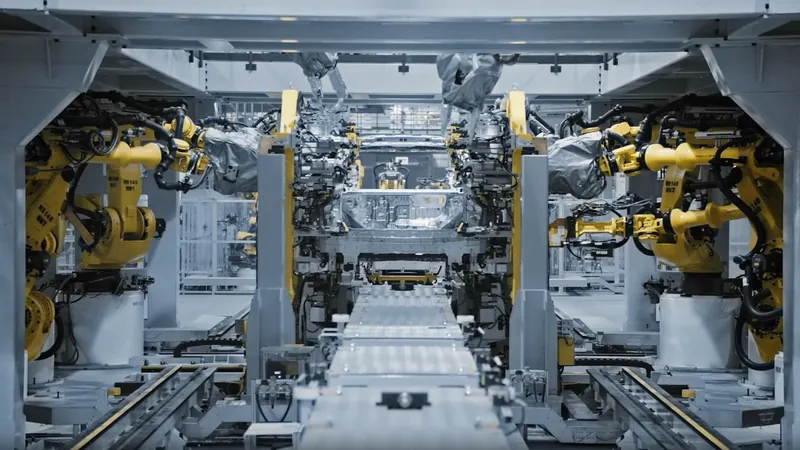
The most important — and most easily overlooked — point in this configuration: FANUC does not make the DED tool itself. The elemental technologies of melting and stacking are entrusted to outside suppliers; FANUC creates value through its home strengths of accuracy, rigidity and control, then combines the two into an overall offering for the market. The benefit is that each party does what it does best; the risk is just as obvious — the key tool that governs forming quality is not in its own hands, so who is responsible for making the two mesh and guaranteeing the quality of the whole system? However high the robot's accuracy climbs, it cannot by itself determine the overall performance and forming quality of a metal AM system. The answer to this question will directly decide whether the offering reads as a product or as an engineering job in customers' eyes.
For existing M-800 users there is one more practical topic: the same robot could in principle extend from cutting into metal AM. But there are conditions — a DED tool has to be added, forming process parameters have to be accumulated — and equipment assets purchased for cutting may not convert directly. It is less a free bonus than a proposition still to be verified.
Next Watchpoint: Whether Trajectory Accuracy Converts into Consistent Part Quality
Whether the DED approach is practical comes down, in the end, to three things: forming speed, deposit quality, and the range of usable materials. However much the robot's absolute accuracy improves, whether the forming process — with all its melting and solidifying — runs stably, and how tightly part-to-part quality variation can be held, will still be judged by the record on real parts. The focus is those three points — speed, quality, materials — and none of them is decided by the robot alone; each depends on how it performs in combination with the DED tool. ±0.1 mm is a handsome ticket in the door, but the race has only just begun. For those of us in the used-equipment and maintenance trade, there is one thing to note down first: if this combination gathers momentum, "absolute accuracy" will soon be one more item on the checklist for evaluating machining robots. Related reading: used robot sales, FANUC × NVIDIA closing the simulation gap.
Further Reading
- Real-Machine Control in Simulation: FANUC × NVIDIA
- Kawasaki, FANUC and Yaskawa Build a Data Foundation
- Brand Coverage and Model Resources