FANUC and NVIDIA's recent collaboration can be boiled down to one sentence: make the robot in the simulation environment run the very same FANUC control algorithms that run on the real machine. The two have already demonstrated a dual-arm collaborative robot handling soft objects, but a timeline for commercial deployment on mass-production lines has not been announced. What is really worth watching here is not the demo footage but the seam it tries to narrow — the "Sim-to-Real" gap — and how many hours of teaching and motion-validation work can ultimately be moved off the factory floor and into simulation.
First, the facts:
- FANUC and NVIDIA are integrating three layers: learning in simulation, interfacing with real-machine control, and AI inference on the robot;
- In the demonstration, the dual-arm collaborative robot CRX learned skilled workers' motions and completed T-shirt folding; per-piece cycle time, success rate, and reproducibility after repositioning were not disclosed;
- The core approach is running the same FANUC control as the real machine inside the simulation, narrowing the "control-response deviation" half of the Sim-to-Real gap; deviations from environmental conditions do not disappear because of it;
- The edge AI "Jetson Thor" (Jetson T5000 module) delivers more than 7.5 times the AI compute of the previous module, but how much faster obstacle-avoidance response becomes was not stated;
- FANUC plans to prepare 3D models of its entire robot lineup as "SimReady assets"; intended applications are automotive, logistics and food, with the timing of commercial deployment undecided.
Three Layers of Integration, and a CRX That Folds T-Shirts
The technical stack of this collaboration falls roughly into three layers: learning in simulation, interfacing with real-machine control, and AI inference on the robot. Strung together, the flow looks like this: first, NVIDIA's simulation environment Isaac Sim generates large volumes of camera images and robot motions to train the AI model; the model is then hooked up to FANUC's simulation software ROBOGUIDE and to the real-machine control, transferring motions generated in simulation onto the physical machine; on the robot side, the edge AI Jetson Thor handles image recognition and inference. The plant's 3D assets are consolidated on Omniverse (OpenUSD), and the robot foundation model is Isaac GR00T N.
What can be confirmed today is a demonstration built on this entire stack. The most representative scene: the dual-arm collaborative robot CRX folding a T-shirt. It first learns motion data from skilled workers, then reads the state of the fabric from camera images and completes the fold — the point being to break free of fixtures and fixed trajectories and handle soft, shape-shifting objects. But to put it precisely: per-piece cycle time, success rate, and reproducibility after the fabric is rearranged were not published at all. This is not a commercial deployment on a mass-production line; it is the muscle-flexing demo stage.
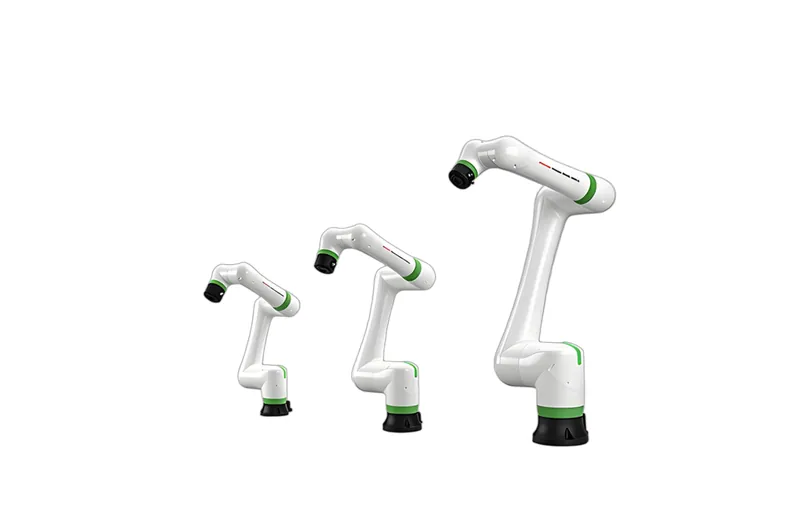
The models' "preparation list" is also worth a note: FANUC plans to turn the 3D models of its entire lineup — from the small CRX collaborative robot with a 3 kg payload to large industrial robots handling 2.3 tons — into SimReady assets, with conveyors, PLCs and optical sensors on the list as well. But how faithfully these models reproduce mass properties and control latency beyond outward shape, and when each model will be provided, should be judged separately and not lumped together.
Why Now: High-Mix Production Has Driven the Labor-Hours Up Against the Wall
Industrial robots have leaned on two crutches all these years: "teaching," where a person walks the robot through each motion on site, and dedicated fixtures customized for every workpiece. As product variety keeps rising, line changeovers get ever more frequent; each changeover means redesigning fixtures and re-teaching trajectories, and start-up hours keep climbing. Nobody who works with this equipment is a stranger to that wall.
What this collaboration targets is precisely the shiftable portion of those hours: motion validation and re-teaching. Worth noting is that NVIDIA's partner list goes far beyond FANUC — ABB, Yaskawa Electric, KUKA and Universal Robots are all on it, as it rallies multiple robot makers around embodied intelligence. This means the axis of competition is expanding from the performance of the robot body to the fidelity of simulation models, the way they interface with real-machine control, and the coverage of the learning environment. As for FANUC, there is no basis at this point to declare it ahead of its peers; bringing the same control as the real machine into the simulation side is its distinctive move this time.
The Part of the Gap That Shrinks, and the Part That Doesn't
The technically weightiest move is having the robot in simulation run exactly the same FANUC control algorithms as the real machine. The Sim-to-Real gap actually has two layers: the deviation in control response, and the deviation in environmental conditions — images, lighting, friction, part-to-part variation. Bringing real-machine control into simulation narrows the first layer; the second still has to be covered by polishing the training data and fine-tuning on the physical machine, and it does not vanish because of this one move.
On the robot side, the Jetson Thor (module name T5000) raises AI compute to more than 7.5 times the previous module, per NVIDIA. With more compute headroom, the robot should in theory handle tasks like environmental perception and dynamic obstacle avoidance with more margin. But to what extent that multiple converts into actual improvements in recognition latency or obstacle-avoidance response time was not stated — compute is raw material, not the finished product.
There was also a demo on the programming side: natural-language instructions generating Python code directly. The direction is a complement to manual teaching in the teach-pendant (TP) language. But who validates the generated code, and how it is converted into FANUC control programs and run safely on real machines, is another unavoidable step — and the demo did not cover it.
Which Parts of the Floor Can Move to Simulation First
Embodied intelligence is not aiming to swallow the production line in one bite; it is about shifting parts of the deployment process forward into simulation. But the degree to which each step can be replaced varies widely and has to be weighed one by one.
At the line-introduction stage, virtual commissioning is already practical: before work begins on site, interference and reach are verified in simulation. But stay clear-eyed: the fixtures that guarantee workpiece position and machining quality do not disappear because of it. For part pickup, if 3D vision and physics computation can determine a workpiece's position and orientation, dependence on dedicated fixtures and feeders can indeed be reduced. Safety demands extra caution: control that senses its surroundings and avoids obstacles dynamically may serve as an auxiliary means of reducing stoppage frequency, but whether it can replace segregated operation or safety-sensor-triggered stops must be verified separately, together with safety certification and shutdown design for failures — dynamic obstacle avoidance and standards-based safety functions cannot be discussed on the same level.
As for the division of roles: FANUC holds the real-machine control and the robot assets; NVIDIA supplies the simulation, the learning platforms and the edge compute. Whether this combination can stand firm on mass-production floors depends on the two companies' software update cadence, and on whether responsibility boundaries can be drawn clearly when something fails.
The Yardstick: Total Deployment Time, Not How Good the Demo Looks
The two companies have also sketched a more distant picture: controls learned in simulation flowing continuously onto real machines — training runs at night, updates pushed out the next morning. The direction is seductive, but at this stage it is only a vision — how frequent the updates would be, and how changes get validated before going into a live machine, both remain unanswered.
Back to the floor-level view. When making deployment decisions, the comparison should not be how novel the technology is, but how much four things change versus the conventional way: line start-up time, per-cycle processing time, success rate after conditions change, and the labor required for safety validation. If total hours — fixtures and safety design included — do not come down, AI compute multiples alone will not buy a return on investment. The pragmatic first step is probably interference checking and motion validation, where results "can be measured without stopping the real line." The watershed for mass-production adoption has never been whether the demo looks good; it is whether total deployment time — including re-teaching on site — actually comes down. Teaching and commissioning FANUC models happens to be the thickest part of our daily business — if simulation genuinely eats a sizable chunk of it, the whole workflow of integration and maintenance will have to be resequenced. Related reading: repair craft knowledge base, FANUC M-800 enters metal 3D printing.
Further Reading
- Kawasaki, FANUC and Yaskawa Build a Data Foundation
- FANUC's ±0.1 mm Metal Additive Gambit
- FANUC Alarm Code Quick Reference